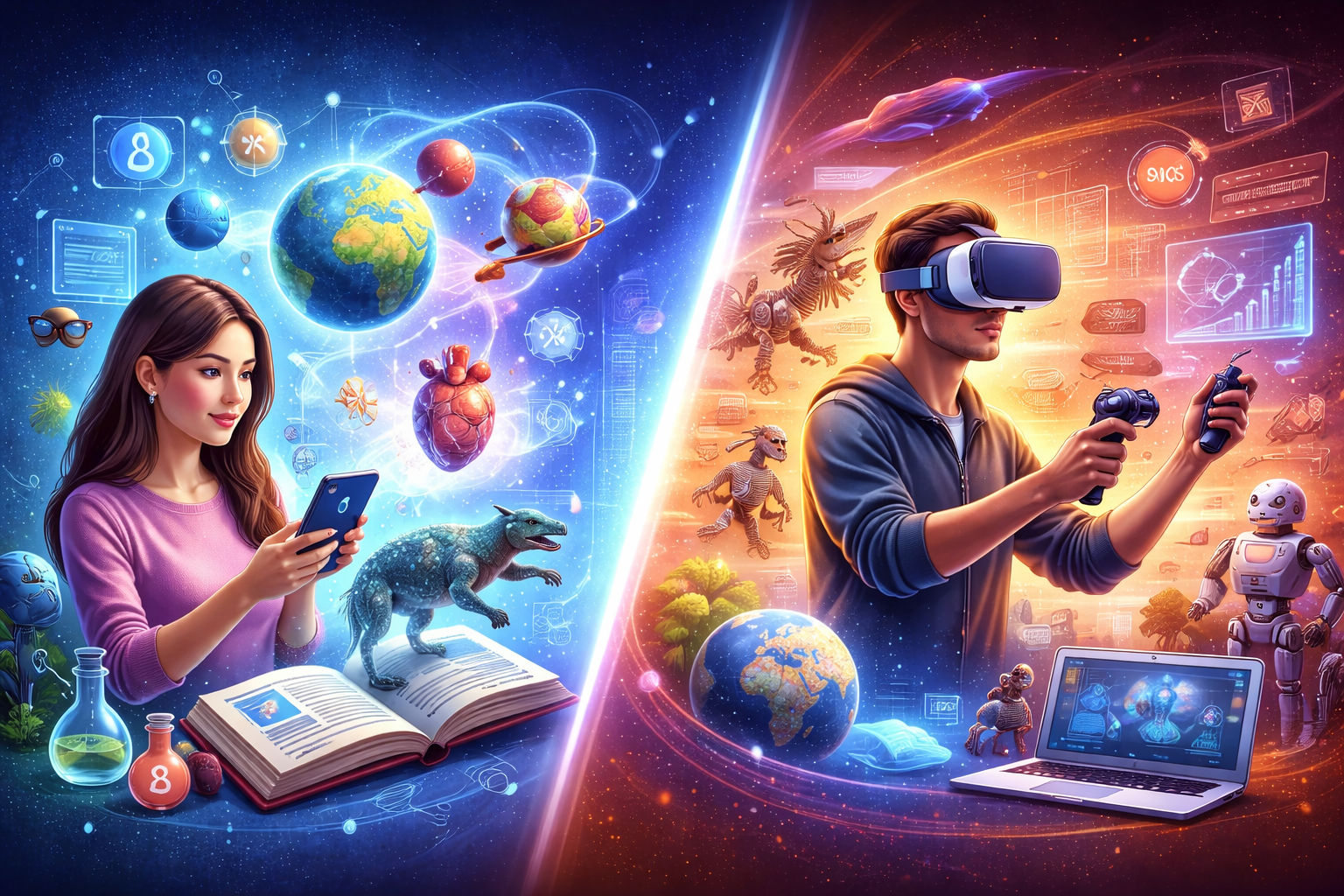
Technology is rapidly transforming how we learn, and two of the most exciting innovations leading this change are Augmented Reality (AR) and Virtual Reality (VR). While both offer immersive experiences, they are often confused with one another.
Understanding the difference between AR and VR—and their impact on education—can help students, educators, and institutions make better use of these powerful tools.
What is Augmented Reality (AR)?
Augmented Reality (AR) enhances the real world by overlaying digital elements such as images, sounds, or text onto your physical surroundings.
Instead of replacing reality, AR adds to it.
Examples of AR:
- Mobile apps that show 3D models through your camera
- Interactive textbooks with animations
- AR-based learning apps for science and history
A well-known example is Pokémon GO, where digital characters appear in real-world locations.
What is Virtual Reality (VR)?
Virtual Reality (VR) creates a completely immersive digital environment that replaces the real world. Users typically wear headsets to enter a simulated space.
Examples of VR:
- Virtual classrooms
- 3D simulations for medical training
- Historical recreations for immersive learning
Devices like Oculus Quest 2 allow users to explore fully virtual worlds.
Key Differences Between AR and VR
| Feature | Augmented Reality (AR) | Virtual Reality (VR) |
|---|---|---|
| Environment | Real world + digital overlay | Fully virtual world |
| Device | Smartphone, tablet | VR headset |
| Immersion Level | Partial immersion | Full immersion |
| Interaction | Enhances real-world interaction | Replaces real-world interaction |
In simple terms:
AR adds to reality
VR replaces reality
Impact of AR and VR in Education
Both AR and VR are revolutionizing education by making learning more interactive, engaging, and effective.
1. Enhanced Visualization
Complex subjects become easier to understand when students can see and interact with concepts.
- AR can display 3D models of the human body
- VR can take students inside a virtual laboratory
This is especially useful in subjects like science, engineering, and medicine.
2. Experiential Learning
VR enables learning by doing, not just reading or listening.
Students can:
- Perform virtual experiments
- Explore space or underwater environments
- Visit historical sites without leaving the classroom
For example, platforms like Google Expeditions allow virtual field trips around the world.
3. Increased Engagement
Traditional lectures can sometimes feel monotonous. AR and VR make learning:
- Interactive
- Fun
- Highly engaging
Gamified learning experiences keep students motivated and focused.
4. Accessibility and Remote Learning
VR can create virtual classrooms, allowing students from different locations to learn together.
AR apps can turn any smartphone into a learning tool, making education more accessible.
5. Challenges to Consider
Despite their benefits, AR and VR also come with limitations:
- High cost of VR equipment
- Need for technical infrastructure
- Potential screen fatigue
- Learning curve for teachers
Adopting these technologies requires careful planning and investment.
The Future of AR and VR in Education
As technology becomes more affordable and advanced, AR and VR are expected to become mainstream in classrooms.
Future possibilities include:
- Fully immersive digital campuses
- AI-powered personalized learning environments
- Real-time collaboration in virtual spaces
These innovations could redefine how knowledge is delivered and experienced.
Final Thoughts
Augmented Reality and Virtual Reality are not just futuristic concepts—they are already transforming education today.
While AR enhances the real world, VR creates entirely new ones, and both offer unique advantages for learning. By integrating these technologies effectively, educators can create more engaging, interactive, and impactful learning experiences.